
French · verb conjugation

Daily Verb Lesson: French for accuse each other is s'accuser
1 min readThe French for accuse each other is the regular ER reflexive verb s'accuser. To remember this, imagine pleading, "See, you ACCUSE me and I take the blame!"
to accuse each other

s'accuser
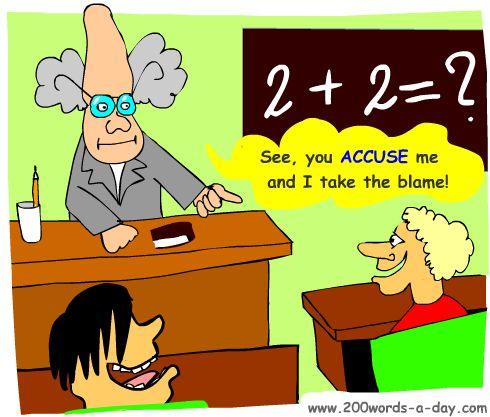
Sounds like “accuse”, so imagine…
pleading, "See, you ACCUSE me and I take the blame!"
s'accuser can also mean: to accuse each other; to take the blame; to become more marked. Related words include:
- accuser (v) : to accuse, to charge. / (l') accusé/e : (the) accused (m/f).
- l'accusation (nf) : accusation; charge; the prosecution.
- l'accusateur / l'accusatrice (public) (nm/f) : accuser / (public) prosecutor.
The meaning of verbs can change when in the Reflexive. They often show action done to oneself or between each other, and use the Reflexive Pronoun (me, te, se, nous, vous, se). Reflexive verbs also take être in the compound tenses and the Past Participle agrees in number and gender with the subject.
Learn and remember French vocab, try innovative memory techniques like Cartoon Memory Triggers. To remember a word, just think of the pic!
| VERB CONJUGATION TABLE s'accuser | ||||||
|---|---|---|---|---|---|---|
| Simple Tenses s'accuser Present Participle: s'accusant | ||||||
| Tense | je m' | tu t' | il s' | nous nous | vous vous | ils s' |
| PresentPrésentaccuse | accuse | accuses | accuse | accusons | accusez | accusent |
| Past ImperfectImparfaitaccused | accusais | accusais | accusait | accusions | accusiez | accusaient |
| Simple PastPassé Simpleaccused | accusai | accusas | accusa | accusâmes | accusâtes | accusèrent |
| FutureFuturwill accuse | accuserai | accuseras | accusera | accuserons | accuserez | accuseront |
| ConditionalConditionnelwould accuse | accuserais | accuserais | accuserait | accuserions | accuseriez | accuseraient |
| SubjunctiveSubjonctifmay accuse | accuse | accuses | accuse | accusions | accusiez | accusent |
| Compound Tenses accuser Past Participle: s'être accusé(e)(s) | ||||||
| Present PerfectPassé Composéhave accused | me suis | t'es | s'est | nous sommes | vous êtes | se sont |
| accusé(e) | accusé(e) | accusé(e) | accusé(e)s | accusé(e)s | accusé(e)s | |
| Past PerfectPlus-que-Parfaithad accused | m'étais | t'étais | s'était | nous étions | vour étiez | s'étaient |
| accusé(e) | accusé(e) | accusé(e) | accusé(e)s | accusé(e)s | accusé(e)s | |
| Future PerfectFutur Antérieurwill have accused | me serai | te seras | se sera | nous serons | vous serez | se seront |
| accusé(e) | accusé(e) | accusé(e) | accusé(e)s | accusé(e)s | accusé(e)s | |
| Conditional PerfectConditionnel Passéwould have accused | me seraisaccusé(e) | te seraisaccusé(e) | se seraitaccusé(e) | nous serionsaccusé(e)s | vous seriez accusé(e)s | se seraient accusé(e)s |
| Imperative*Imperatifaccuse! | – | accuse-toi ! | – | accusons-nous ! | accusez-vous ! | – |
* No imperative for je m', il s' or ils s': commands are only given to the people you're talking to (or to “us”).
Red letters are irregular: where se-accuser breaks the regular pattern.
- s'accuser is a regular ER reflexive verb. There are over 5,000 ER verbs these being the most common verbs in French.
- Learn s'accuser and it will reinforce the pattern for ALL those other ER verbs.
- Do these verbs every day for a month and you will have a solid knowledge of the ER verbs' conjugation patterns.
More Verbs like the French verb s'accuser - French for accuse each other
- There are many more French Verb Tables like this one.
- You can more easily remember words and verbs like the French verb s'accuser - French for accuse each other - using the techniques of the world's Memory Masters.
Try 200 Words a Day
Stop forgetting what you learned yesterday
Each word comes with a cartoon memory trigger that locks it into long-term memory. Try 10 lessons free in every vocab course.